

YEIDA Notices & Compliance
YEIDA Notice for Non-Construction: What to Do & How to Respond (2026 Guide)
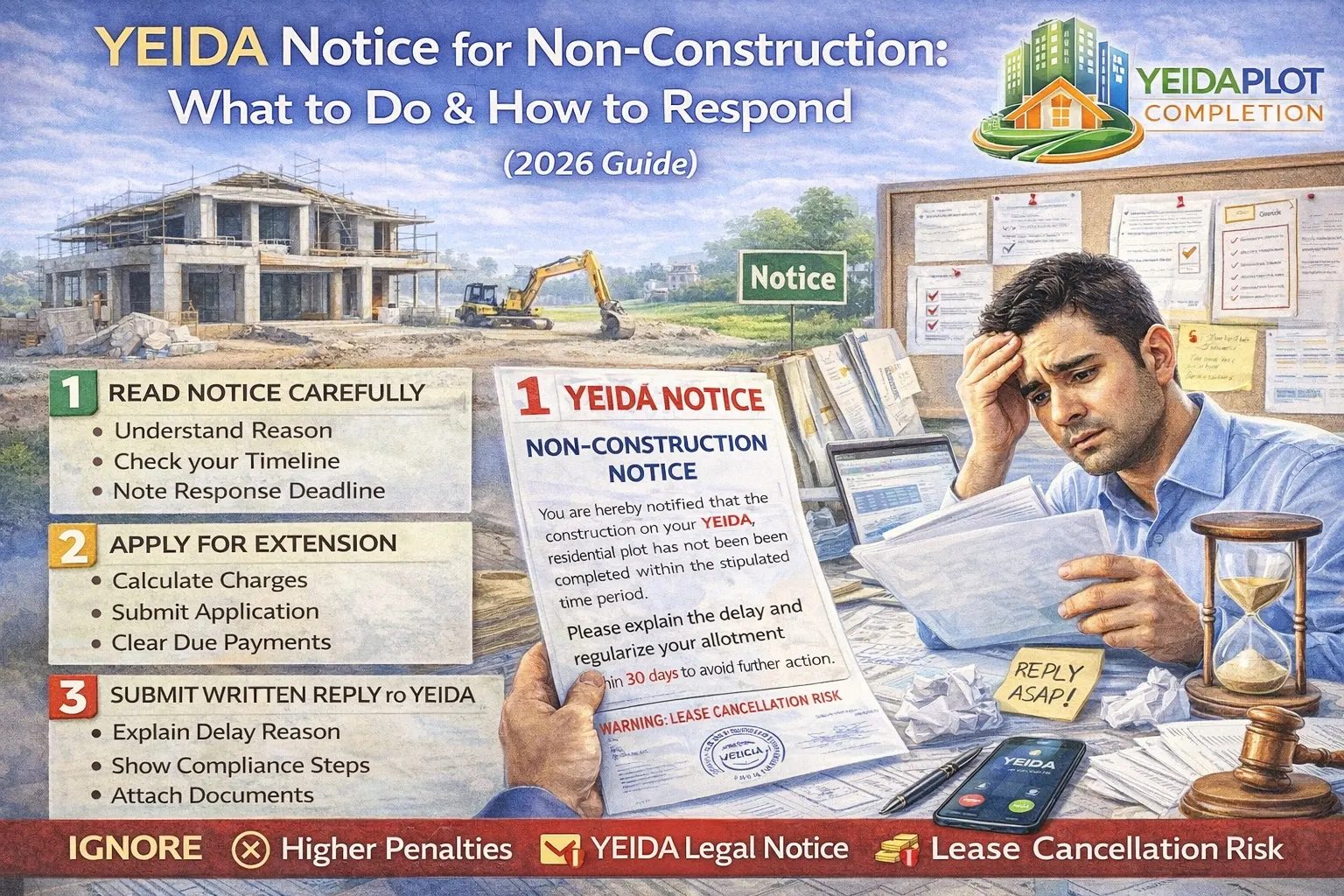
Receiving a YEIDA notice for non-construction can be stressful. Many residential plot owners along the Yamuna Expressway receive notices when they fail to complete construction within the prescribed timeline.
If you’ve received such a notice — don’t panic. In most cases, the situation can be regularized if handled properly and on time.
In this guide, we explain:
Why YEIDA sends non-construction notices
What the notice means
Step-by-step process to respond
How to avoid penalties or cancellation
Why Does YEIDA Issue a Non-Construction Notice?
YEIDA (Yamuna Expressway Industrial Development Authority) issues notices when:
Construction is not started within the allowed time
Minimum mandatory construction is incomplete
Completion certificate has not been applied for
Extension charges remain unpaid
As per allotment terms, residential plot owners must complete construction within the specified period (generally 5 years from possession, subject to scheme terms).
If this timeline is exceeded, YEIDA may initiate compliance action.
What Does a YEIDA Non-Construction Notice Usually Contain?
A typical notice may include:
Plot number and sector details
Reference to allotment conditions
Mention of delay period
Demand for explanation or compliance
Time limit (usually 15–30 days) to respond
In serious cases, it may mention:
Penalty demand
Extension charges
Warning of lease cancellation
Step-by-Step: What To Do After Receiving the Notice
Step 1: Carefully Read the Notice
Check:
The exact reason mentioned
Delay period calculated
Deadline for response
Do not ignore the timeline mentioned in the notice.
Step 2: Check Your Construction Status
Evaluate:
Has construction started?
Is minimum construction completed?
Have you applied for plan approval?
Are extension charges pending?
Understanding your status helps decide the response strategy.
Step 3: Apply for Extension (If Required)
If construction is incomplete:
Apply for formal extension
Pay applicable extension charges
Clear any outstanding dues
Extension approval often regularizes the delay.
Step 4: Submit Written Reply to YEIDA
Your reply should:
Acknowledge the notice
Explain the reason for delay
Mention corrective steps taken
Attach supporting documents
A properly drafted reply improves the chances of smooth regularization.
Step 5: Start or Complete Construction Immediately
If construction has not started:
Begin minimum mandatory construction
Ensure approved building plans
Maintain compliance with by-laws
Demonstrating active progress reduces further risk.
What Happens If You Ignore the Notice?
Ignoring a YEIDA notice can lead to:
Heavy penalty accumulation
Higher extension charges
Rejection of future approvals
Legal proceedings
Lease cancellation (in extreme cases)
Timely response is critical to protect your plot investment.
Can YEIDA Cancel the Plot for Non-Construction?
Yes, YEIDA has the authority to cancel allotment in prolonged non-compliance cases.
However, cancellation usually happens only after:
Multiple notices
Failure to pay dues
Continued inaction
Most cases can be resolved if handled professionally and on time.
Common Reasons for Construction Delay
Many plot owners delay construction due to:
Financial planning issues
Lack of clarity on rules
Confusion about minimum construction requirement
Waiting for better resale market
NRI ownership complications
Whatever the reason, delaying response to notice makes things worse.
How to Avoid Future Notices
To stay compliant:
Understand your construction deadline
Track extension eligibility
Complete minimum required construction
Apply for completion certificate
Maintain proper documentation
Proactive compliance avoids stress and extra financial burden.
Professional Help Makes the Process Easier
Handling notices, extensions, and compliance paperwork can be complex. Professional YEIDA-focused services help you:
Draft proper notice response
Calculate exact extension charges
Plan minimum construction legally
Obtain completion certificate smoothly
Timely professional intervention often saves significant money.
Frequently Asked Questions (FAQs)
Q1. How many days do I get to respond to a YEIDA notice?
Usually 15–30 days, depending on the notice.
Q2. Can I sell my plot after receiving a notice?
It becomes difficult unless dues and compliance are cleared.
Q3. Is paying extension charges enough to close the notice?
Generally yes, if construction is completed within extended time.
Q4. Can I request more time after receiving notice?
Yes, through formal extension application.
Q5. Does YEIDA physically inspect plots before issuing notice?
In many cases, yes — inspections are conducted sector-wise.
Final Thoughts
A YEIDA notice for non-construction is serious — but manageable.
The key is:
Do not ignore it
Respond within deadline
Regularize through extension
Complete minimum construction
Apply for completion certificate
With proper action, most non-construction notices can be resolved without long-term damage.
If you need guidance on responding to a YEIDA notice or completing your plot legally, expert support can help protect your investment and avoid unnecessary penalties.